
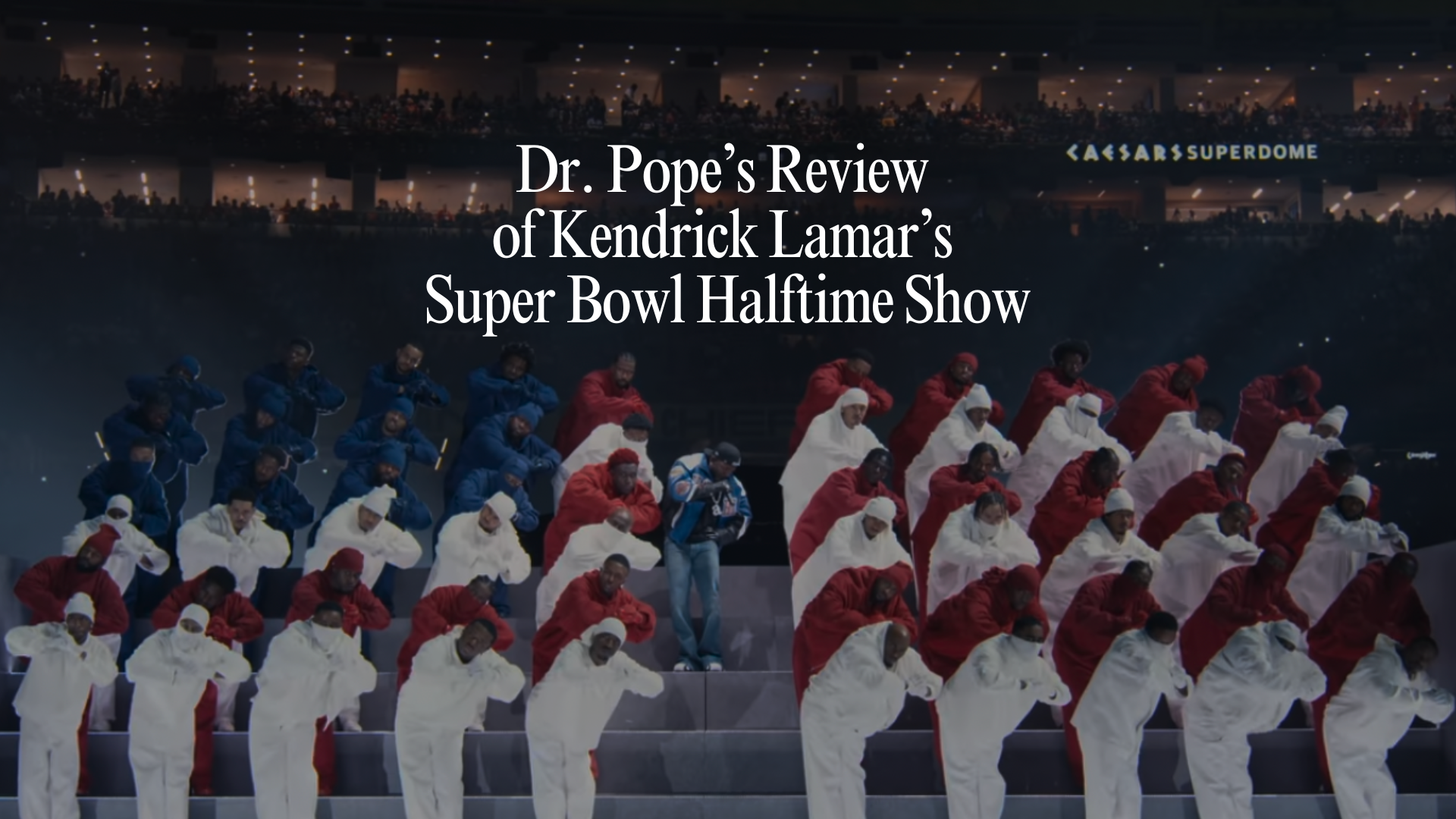
Kendrick Lamar’s Super Bowl 59 halftime show wasn’t just a performance—it was an urgent, visual narrative about race, power, and survival in America. Through symbolic set design, precise choreography, and striking social commentary, Lamar transformed the Super Bowl stage into a metaphor for systemic oppression, highlighting themes of resilience, cultural assertion, and the struggle for liberation.
A Stage as a Rigged Game: Life or Death
Lamar’s set design resembled a video game, with the stage appearing as a controller-like structure, symbolizing the “game of life.” His words—
“Forty acres in the mule, this is bigger than the music”
This is a direct reference to the post-Civil War promise of reparations to formerly enslaved Black Americans—40 acres of land and a mule to help them build economic independence. However, this promise was never fulfilled, highlighting the historical betrayal of Black communities by the American government. By invoking this phrase at the start of his performance, Lamar immediately grounds the show in a larger conversation about systemic racial injustice and economic disparity.

The uniformity in motion reinforced the idea that Black Americans are still trapped in a rigged system, where opportunities for success are systematically limited.
The Revolution is Not Televised
Lamar’s performance subverted the Super Bowl’s role as a grand spectacle, referencing Gil Scott-Heron’s iconic poem:
“The revolution will not be televised.”
Scott-Heron’s 1971 work critiques how mass media distorts and pacifies real activism, turning political struggles into entertainment for passive consumption. Lamar’s halftime show, one of the most-watched television broadcasts of the year, ironically challenges the very idea that true revolutionary change can happen on a stage built for corporate-sponsored entertainment. By fixating on that line Lamar pointed to the idea that what America watches on TV is often a distraction from deeper, unresolved systemic issues.
His use of shadowy lighting and abrupt transitions instill an uneasy feeling while watching the show.

Uncle Sam as Samuel L. Jackson: A Watchful Presence
Samuel L. Jackson represented Uncle Sam, tradtitionally representing an idealized, faceless figure of American propaganda but Jackson emphasized his role as Uncle Sam to symbolize U.S. nationalism and control.
At one point, Jackson’s voice boomed through the stadium, sneering:
“Too ghetto, too loud.”

This was a direct reference to how Black expression—whether in music, sports, or culture—is often policed, criticized, and only deemed acceptable when it fits into a sanitized, commercialized version. By having Jackson, an outspoken cultural figure, embody Uncle Sam, Lamar highlights the contradictions of America’s relationship with Black excellence—celebrated when it’s profitable, yet controlled when it threatens the status quo.
The Red, White, and Blue Imagery
Lamar used the American flag not as a symbol of pride, but as a visual indictment of broken promises.

Throughout the performance, the flag appeared in distorted and even split in half in one scene, serving as a reminder of the contradiction between America’s ideals of freedom and its history of racial oppression. This is a continuation of Lamar’s ongoing critique of state violence, as seen in his past performances of “Alright”, where he raps about police brutality, and condemns America’s role in perpetuating racial injustice.

Military and Policing References
Lamar’s backup dancers’ robotic, uniformed movements of marching, mirrored military drills and prison labor, underscoring themes of dehumanization and mass incarceration.
Their precise formations evoked images of the militarization of policing, which disproportionately targets Black communities. The prison-industrial complex, where private prisons profit from mass incarceration.
This segment visually reinforced how the system strips individuality from marginalized people, turning them into numbers within a larger machine.

“Can’t Fake Influence”
At one point in the performance, Kendrick Lamar delivered the line:
“They tried to rig the game, but you can’t fake influence.”
This phrase encapsulates Lamar’s larger critique of industry manipulation, cultural authenticity, and systemic barriers. Breaking it down:
“They tried to rig the game” references the idea that the entertainment industry attempt to control who rises and who falls. Success in music, sports, and culture is often influenced by gatekeepers, algorithms, and financial backing rather than raw talent or social impact. “But you can’t fake influence” – Despite industry efforts to manufacture success, true cultural power cannot be fabricated. Influence is earned through authenticity, community respect, and historical significance.
“Nice and Calm, That’s What America Wants” (Uncle Sam’s Voice)
During Kendrick Lamar’s Super Bowl halftime show, the character of Uncle Sam, played by Samuel L. Jackson, delivers the chilling line:
“Nice and calm, that’s what America wants.”

Spoken in a condescending, almost mocking tone, this line serves as a sarcastic critique of America’s expectations for Black expression, protest, and success. Uncle Sam—the embodiment of American power—isn’t making a neutral observation. He’s enforcing a rule. Uncle Sam, as a symbol of American authority, control, and historical oppression, reminds Black artists and citizens that they are expected to be “nice and calm”—meaning non-disruptive, non-political, and non-threatening. This reflects how America rewards Black entertainers when they conform to comfortable, feel-good narratives but punishes them when they speak out against injustice.
Throughout history, Black artists, activists, and leaders have been told to “calm down” when addressing systemic oppression. The phrase reflects the same language used to dismiss civil rights movements—from Martin Luther King Jr. being told to “wait” for justice, to modern activists being called “too radical.
Squid Game-Esque Symbolism: Survival of the Fittest
Lamar’s dancers wore sweatsuits similar to those in “Squid Game”, a show that critiques capitalist exploitation and wealth disparity. Additionally, the set as designed like a game controller reinforces the parallel that the dancers are enacting players in a “game” of life.

The South Korean series Squid Game became a global phenomenon because it exposed the brutal realities of capitalism, where individuals are forced to compete against each other in a zero-sum game, often for the benefit of those in power. Lamar’s performance adopted this theme to make a direct statement about Black survival in America.
In Squid Game, debt-ridden players are manipulated into competing in deadly games for the amusement of the wealthy elite. Lamar’s dancers wearing similar uniforms to those in Squid Game symbolized how Black Americans are often placed in a different kind of game—one where economic survival is dictated by institutional forces beyond their control. This aligns with Lamar’s broader critique of wealth inequality, seen in his past lyrics about financial struggles and economic exclusion.
Did Kendrick Lamar Mention Drake in the Super Bowl Halftime Performance?
Yes—Kendrick Lamar made at least one direct reference to Drake during his Super Bowl 59 halftime show, in addition to several indirect thematic nods.
“Certified lover boy, certified, ah” This line is an unmistakable reference to Drake’s 2021 album Certified Lover Boy.
While Lamar didn’t dwell on Drake by name, several lines and visual themes in his performance alluded to their ongoing feud and Lamar’s larger critique of industry figures profiting from hip-hop while lacking cultural authenticity.
“Ain’t no other king in this rap than the siblings.”
This line reinforces Lamar’s position as hip-hop royalty, subtly dismissing Drake’s claims to the throne.
Lamar’s Super Bowl halftime show wasn’t just about Drake—it was about America, race, power, and systemic struggles. However, by weaving in this one direct line and several layered references, he ensured that the tension between the two remained part of the conversation.
Religious and Prophetic Undertones
Throughout the performance, Lamar’s gestures and posture resembled that of a preacher or prophet. He knelt, raised his arms toward the heavens, and delivered lines with sermon-like conviction.
This segment alluded to themes of faith & survival—how belief sustains marginalized communities. Martyrdom—how Black leaders throughout history have sacrificed for justice.
The dramatic lighting, with a single beam illuminating Lamar, reinforced the sense of divine intervention and spiritual leadership.

Hip-Hop as Battleground
Kendrick Lamar’s Super Bowl 59 halftime performance was more than just entertainment—it was a bold statement that hip-hop is not merely a genre, but a movement, a form of resistance, and a living archive of Black struggle and triumph.
During the performance, Lamar declared:
“This is bigger than the music.”
This powerful phrase reinforced the idea that hip-hop extends far beyond beats and rhymes. It is a cultural force that has shaped social movements, redefined narratives, and given a voice to the oppressed.
Since its origins in the Bronx during the 1970s, hip-hop has functioned as a form of oral history, documenting the lived realities of marginalized communities.
Public Enemy’s Fight the Power (1989) became an anthem of resistance, calling out government corruption and racial injustice, N.W.A.’s F Tha Police* (1988)** was a raw, unfiltered response to police brutality and racial profiling—themes still central to Lamar’s music. Lamar’s own work, particularly To Pimp a Butterfly and DAMN., continues this tradition—his lyrics act as historical records of racial inequality, self-discovery, and Black resilience. Hip-hop’s role as a tool for activism extends beyond the U.S., reshaping national identities and pushing back against exclusionary narratives elsewhere.

In Canada, hip-hop has played a crucial role in challenging the perception of the country as an exclusively “white rock and folk nation”. In 1998, the Vancouver-based hip-hop group Rascalz released “Northern Touch”, featuring Toronto artists Checkmate, Choclair, Kardinal Offishall, and Thrust. The song was a pivotal moment in Canadian hip-hop, demonstrating the diverse talent that mainstream media had long ignored. In an interview with CBC, Sol Guy emphasized the song’s significance at a time when Canadian radio stations refused to play “Black music”. Hip-hop artists in Canada have historically fought for representation, directly challenging industry gatekeeping and structural bias. This was evident in the 1991 protest song “Can’t Repress the Cause”, created by a multiracial artist collective called Dance Appeal. The song was a direct response to the Canadian Radio-television and Telecommunications Commission (CRTC), which limited airtime for hip-hop, reggae, R&B, and dance music. The track openly criticized this exclusion with lyrics like: “We are all in the same game—hip-hop, house, and R&B is what we design. Without dance radio, Toronto will get left behind…local radio ain’t got no soul. By using hip-hop as a tool for cultural assertion and resistance, many Canadian artists shared similar struggles for visibility and equity that Lamar has continuously addressed in his work.
Lamar’s statement, “This is bigger than the music,” was not just a reflection on hip-hop’s past—it was a declaration that the genre is still a tool for activism, identity, and truth Hip-hop is not here for passive consumption. It is a call to action.
“Turn this TV off” Americanness and the Idea of Inclusion
Throughout Kendrick Lamar’s Super Bowl 59 halftime performance, one of the most striking and repetitive chants was:
“Turn this TV off.”
This phrase wasn’t just an artistic choice—it was a deliberate rejection of mainstream media’s power to control narratives, distort reality, and distract from deeper systemic issues. By repeating this line, Lamar subtly encouraged his audience to question what they consume, recognize media manipulation, and seek the truth beyond the spectacle of corporate entertainment.With millions of dollars spent on advertising, sponsorships, and brand endorsements, the Superbowl is not just a football game—it’s a carefully curated spectacle designed to sell products, reinforce cultural norms, and dictate mainstream discourse.
Television has long been used as a tool to shape public perception, sometimes in ways that distort, sanitize, or suppress uncomfortable truths. News networks have historically framed protests, civil rights movements, and Black resistance as “threats” or “riots”, rather than legitimate struggles for justice. Entertainment often glorifies Canadian or American exceptionalism while avoiding conversations about racism, inequality, and systemic oppression. Instead of blindly accepting the narratives pushed by corporate media, Lamar’s chant urged the audience to look deeper, to question what they’re being told, and to recognize that real change happens off-screen.
By saying “Turn this TV off”, Lamar could have been encouraging people to disconnect from the distraction of entertainment and focus on real-life issues. The chant might also be interpreted as a challenge to the audience: Will you just watch this performance and move on, or will you actually engage with the ideas presented? It’s a reminder that awareness without action is meaningless—passively watching a politically charged performance is not enough if viewers don’t also reflect, discuss, and work toward change.

A Masterpiece of Protest and Performance
Kendrick Lamar’s Super Bowl halftime show was one of the most politically charged in history. Through symbolism, protest tradition, and hip-hop’s legacy, Lamar crafted a performance that exposed systemic oppression while celebrating Black resilience.
At a time when racial justice conversations are being silenced, his performance was a defiant act of truth-telling on the world’s biggest stage.
Images taken from: https://youtu.be/KDorKy-13ak?si=UeKhqdNhp-83QQs8
About Dr. Amara Pope:
Dr. Amara Pope is a Ph.D. graduate in Media Studies, marketing communications manager, and speaker specializing in digital storytelling, brand identity, and cultural representation. Her Ph.D. research explores how artists like Drake, Justin Bieber, and Jessie Reyez redefine Canadian identity through online marketing and R&B music. Amara’s expertise spans academia and industry, with extensive experience in content strategy, audience engagement, and thought leadership.
